
If you’ve ever wondered whether you’re training too hard, too easy, or just spinning your wheels, heart rate training zones may be the missing link. In this episode of the Find Your Edge podcast, Coach Chris Newport breaks down exactly how heart rate zones work, why common formulas fall short, and how proper testing can transform your training efficiency and results.
Why the 220 Minus Age Formula Falls Short
The classic “220 minus your age” formula is still widely used—but it relies on population averages, not your physiology. As Chris explains, lab testing reveals your actual heart rate responses, allowing you to train harder when appropriate and easier when needed—without wasting time or energy.
In one real-world case study, a man in his mid-60s discovered his true Zone 2 heart rate was over 10 beats higher than predicted, instantly expanding his effective training range.
Understanding the Five Heart Rate Training Zones
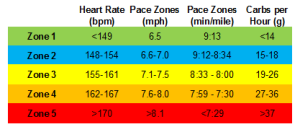
At The Endurance Edge, we use a five-zone model based on how your body produces and clears energy:
- Zone 1–2: High fat utilization, low lactate, aerobic base, and longevity
- Zone 3: “The mushy middle” – not wrong, but should be used intentionally
- Zone 4: Threshold training where fitness adaptations skyrocket
- Zone 5: Short, high-intensity efforts using primarily carbohydrates
Roughly 70–80% of training should occur in Zone 2, with targeted Zone 4 and Zone 5 work layered in strategically.
Why Zone 2 Training Is So Powerful
Zone 2 training improves mitochondrial function, fat oxidation, lactate clearance, and cardiovascular efficiency. It also supports:
- Improved endurance performance
- Metabolic health and fat loss
- Reduced burnout and injury risk
- Long-term athletic longevity
If your workouts always feel “kind of hard,” your zones may be off—and your body may never fully adapt.
VO₂ Max, Ventilatory Thresholds, and Lactate Explained
VO₂ max testing measures how much oxygen your body can use to perform work—but even more valuable is how oxygen usage, ventilation, and lactate respond at different intensities.
By identifying:
- VT1: First ventilatory threshold (typically Zone 2)
- VT2: Second ventilatory threshold (near lactate threshold / FTP)
We can precisely define training zones that align with how your body actually performs.
Why Lactate Testing Sharpens Precision
Lactate testing adds another layer of accuracy by showing when your body can no longer clear lactate efficiently. This allows us to:
- Pinpoint true aerobic and threshold cutoffs
- Track fitness improvements over time
- Confirm training effectiveness
In one athlete’s retest, the same running pace produced a heart rate nearly 10 beats lower and dramatically reduced lactate—clear proof that proper training works.
Your Heart Rate Zones Change by Sport
This is one of the most overlooked factors in training:
- Running zones are typically 8–12 bpm higher than cycling
- Cycling zones are lower than running due to reduced gravitational load
- Swimming heart rates are lower still
Training with the wrong sport-specific zones can skew effort, recovery, and data metrics like Training Stress Score.
Lab Testing vs Field Testing: What’s Right for You?
If your goal is general fitness and efficiency, VO₂ max testing alone may be sufficient. If you’re training for an event—Ironman, marathon, ultrarunning, or performance improvement—the combination of VO₂ max and lactate testing is the gold standard.
Field tests like the 12-minute Cooper Test can estimate VO₂ max, but they can’t precisely define Zone 2 or threshold cutoffs.
The Bottom Line: Train Smarter, Not Harder
Heart rate training zones remove guesswork from training. Whether your goal is performance, fat loss, or longevity, knowing your true zones allows you to:
- Maximize results in less time
- Recover better
- Stay consistent for years to come
If you have questions, reach out to us at theenduranceedge.com or send us a DM on Instagram @TheEnduranceEdge. Your next breakthrough might be one test away.
Want more episodes like this? Subscribe to the Find Your Edge Podcast and share this with a training partner who needs it.