
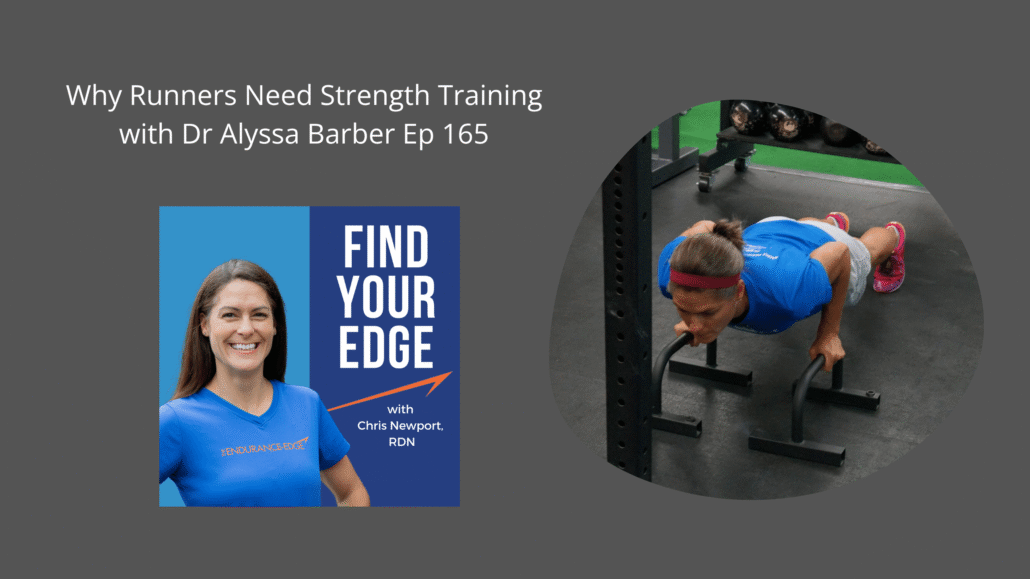
Strength Training for Runners with Dr Alyssa Barber
You run consistently. You follow your training plan. Maybe you even track your heart rate, pace, and VO2max.
But when was the last time you thought about how strong you actually are?
If you’re like many endurance athletes, strength training is the first thing to go when your schedule gets busy. After all, you’re training for a running race or triathlon, not a weightlifting competition.
But what if getting stronger could help you become a better runner?
On this episode of the Find Your Edge Podcast, I’m introducing you to the newest member of our Endurance Edge team, Dr. Alyssa Barber, PhD, an exercise physiologist who loves geeking out about the science of human performance just as much as I do!
Alyssa brings a fascinating background in sports science, strength training, and working directly with athletes.
And her doctoral research explored something every runner should understand: the relationship between strength, movement asymmetries, and running performance.
Let’s get into it!
Why Is Strength Training Important for Runners?
Running is an endurance sport, but every stride also requires your muscles to produce force.
And you don’t just need to produce that force once. You need to do it thousands of times over the course of a workout or race.
Strength training can help runners improve their ability to produce force, develop muscular strength and power, and support efficient movement.
It’s also an important part of building the physical capacity to keep training over time.
And that’s something I care about whether you’re training for your next marathon, your first 5K, or simply want to stay active for decades to come.
What Dr. Alyssa Barber’s Research Found
Alyssa earned her PhD at East Tennessee State University, where she worked with collegiate track and field athletes.
Her research included distance runners, sprinters, and throwers who participated in strength training throughout a semester.
She measured several aspects of physical performance, including:
- Body composition
- Vertical jump performance
- Force production
- Left-to-right strength asymmetries
- Strength and power using an isometric mid-thigh pull
She also examined running race times.
One of the most interesting findings?
The stronger athletes tended to demonstrate fewer asymmetries and faster race performances.
In other words, strength wasn’t just something that mattered in the weight room. It was associated with differences in actual athletic performance.
Now, an important distinction: these results don’t mean that every runner who lifts more will automatically run faster, or that eliminating every asymmetry will prevent injuries.
But the findings support a bigger message: strength training deserves a place in an endurance athlete’s training program.
What Are Strength Asymmetries?
An asymmetry simply means there’s a difference between the left and right sides of your body.
For example, one leg might produce more force than the other.
Some degree of asymmetry is normal. Our bodies aren’t perfectly identical from one side to the other.
But substantial differences may be worth evaluating, particularly when they affect movement or performance.
Alyssa used force plates to measure how athletes produced force with each leg during specific movements.
Her research examined whether strength training could improve those differences over time.
This is particularly interesting for runners because running is essentially a series of single-leg movements.
Which brings us to one of my favorite practical takeaways from our conversation.
Single-Leg Strength Exercises Every Runner Should Know
You don’t necessarily need complicated Olympic lifts or heavy barbells to build strength.
In fact, Alyssa emphasized the importance of choosing movements appropriate for the athlete’s experience and abilities.
Some of the exercises she discussed include:
1. Split squats
Split squats challenge each leg individually and can help develop lower-body strength and control.
You can start with body weight before adding resistance.
2. Step-ups
Step-ups are a practical way to strengthen your legs while working on single-leg force production.
Start with a manageable step height and focus on controlled movement.
3. Single-leg Romanian deadlifts
Single-leg RDLs challenge your posterior chain, balance, and control.
They can be performed with body weight or dumbbells depending on your experience.
4. Lunges
Walking or stationary lunges provide another way to incorporate unilateral strength training.
And remember, you don’t have to start heavy.
Good technique and appropriate progression matter more than trying to impress someone in the gym!
Do Runners Need to Lift Heavy Weights?
Not necessarily, especially when you’re starting out.
Alyssa described how she adjusted strength programs based on the athlete’s event, experience, and capabilities.
Some athletes performed more advanced movements, while others focused on foundational exercises with dumbbells, kettlebells, medicine balls, or body weight.
The important point is that the program matched the athlete.
That’s the same philosophy we use at The Endurance Edge.
A training plan should reflect your goals, current abilities, and the demands of your sport—not simply what someone else is doing.
Strength Training for Performance AND Longevity
One of the things I love about this conversation is that it goes beyond race results.
Yes, we want to help athletes run faster and perform better.
But we also want them to keep doing the activities they love.
Strength matters for everyday movement, too.
Alyssa talked about how her own relationship with training has evolved. As a former collegiate athlete and now a mom, she’s still passionate about strength and power, but the purpose of her workouts has changed.
And isn’t that what lifelong fitness should be about?
Your goals may change, but your ability to move confidently and stay active still matters.
What Does VO2max Testing Have to Do With Training Smarter?
Toward the end of our conversation, Alyssa and I discussed something we see regularly at The Endurance Edge.
Athletes are surrounded by information.
They hear about Zone 2 training, VO2max, heart rate zones, and all the latest performance trends.
But knowing a term isn’t the same as knowing how it applies to your body.
VO2max testing measures your body’s maximum oxygen uptake during exercise.
It’s one useful measure of aerobic fitness, but it doesn’t tell the entire story of your performance.
Your training history, goals, movement capacity, and other physiological factors matter, too.
That’s why we don’t believe in handing everyone the same generic training recommendations.
Testing becomes valuable when you understand what your results mean and how to use them.
Whether you’re preparing for an Ironman or hoping to stay active and healthy as you age, the goal is to make decisions that fit YOU.
Meet Dr. Alyssa Barber, Exercise Physiologist
We’re thrilled to welcome Alyssa to The Endurance Edge team!
Her background includes a PhD in sports science, experience coaching collegiate athletes, and working in exercise physiology labs.
But what I appreciate most is her enthusiasm for helping people understand their bodies.
She loves the science, but she also loves making it useful.
Because at the end of the day, you don’t need another confusing report full of numbers.
You need to understand what those numbers mean and what to do next.
Two Strength Training Tips You Can Apply Right Now
Alyssa closed our conversation with two practical recommendations.
First: Lift.
Strength training is valuable for endurance athletes, but also for anyone who wants to stay capable and active as they age.
Second: Choose exercises you’ll actually do.
A complicated program isn’t helpful if you don’t enjoy it, don’t understand it, or can’t fit it into your life.
Consistency matters.
And if you’re working with a coach, communicate when something in your program isn’t working for you.
The best plan is one you can follow safely and consistently.
Stop Guessing and Start Understanding Your Body
If you’re curious about your own performance metrics, we’re here to help!
At The Endurance Edge in Cary, North Carolina, our metabolic and VO2max testing services help you better understand your physiology so you can make more informed decisions about your training and health.
We don’t just hand you numbers and send you on your way.
We help you understand what those results mean for your goals.
Explore Sweat & Metabolic VO2max Testing
And be sure to listen to the full Find Your Edge Podcast conversation with Dr. Alyssa Barber!
Frequently Asked Questions
Does strength training help runners run faster?
Strength training can support running performance by improving strength and force-production capacity. Alyssa’s research found that stronger collegiate runners tended to have faster race times, although individual results vary.
What strength exercises are good for distance runners?
Squats, split squats, step-ups, lunges, and single-leg Romanian deadlifts are useful options. Exercise selection should match your experience and goals.
Do runners need to lift heavy weights?
Not necessarily. Beginners can develop strength with bodyweight exercises, dumbbells, and other accessible equipment. Progressive overload can be introduced as appropriate.
Can strength training prevent running injuries?
Strength training can be an important part of injury-risk management, but no single exercise guarantees injury prevention. Training load, recovery, biomechanics, and individual injury history also matter.
Is VO2max the best predictor of running performance?
VO2max is an important measure of aerobic capacity, but it isn’t the only determinant of performance. Running economy, threshold-related factors, training, and race execution also contribute.
Where can I get VO2max testing near Raleigh, North Carolina?
The Endurance Edge offers metabolic and VO2max testing at its Cary, NC exercise physiology lab, serving athletes and active adults throughout the Triangle.