
How to Use Your Sweat Rate Pattern to Create Your Hydration Plan
How much should I drink per hour?
It’s one of the most common hydration questions I get from endurance athletes.
But there’s a problem with trying to find one magic number:
Your sweat rate isn’t one number. It’s a pattern.
You might lose a fraction of a liter during an easy run on a cool day and well over a liter during a harder workout in hot, humid conditions.
Same athlete. Different sweat rate.
That doesn’t mean your data is wrong.
It means your body is responding to what you’re asking it to do.
And once you understand those patterns, your hydration needs can become a whole lot less mysterious.
What Is Sweat Rate?
Sweat rate describes how much fluid you lose through sweat over a given amount of time.
But instead of thinking about your sweat rate as one fixed number, it can be more useful to ask:
What does my body typically do under these specific conditions?
Your sweat losses can change based on several factors.
Sport
You may sweat very differently running compared with cycling or swimming.
Even where you train can make a difference. I’ve worked with athletes who sweat significantly more cycling indoors than outside.
Something as simple as adding a fan can change the equation by improving airflow.
Exercise Intensity
As exercise intensity increases, your body produces more heat.
That means your sweat rate during an easy aerobic workout may look very different from your sweat rate during a hard race effort.
Temperature and Humidity
Your environment matters.
A run in 30°F weather is not the same physiological situation as a run in 80°F heat and humidity.
That’s why one sweat-rate calculation from one workout doesn’t necessarily tell you what you’ll need all year.
Individual Physiology
We’ve all trained with that person who finishes absolutely drenched while someone beside them barely looks sweaty.
Sweat rate varies from athlete to athlete.
Your training partner’s hydration plan isn’t automatically your hydration plan.
Why One Sweat Rate Calculation Isn’t Enough
Imagine calculating your sweat rate during a hot July run in North Carolina.
Does that number tell you exactly what you’ll need for a cool October bike ride?
Probably not.
Instead, start looking for your patterns.
In the podcast, I suggest collecting roughly 3–5 observations per sport across different conditions when possible. You don’t need to obsessively measure every workout forever. You’re trying to gather enough information to understand how your body typically responds.
Consider differences in:
- Sport
- Duration
- Intensity
- Temperature
- Humidity/environment
- Indoor versus outdoor training
Over time, those individual observations begin to tell a much more useful story.
Sweat Rate vs. Sweat Sodium: They’re Not the Same Thing
Knowing how much fluid you’re losing is one piece of the hydration puzzle.
Knowing what’s in that sweat gives us another.
Sweat testing can help determine your individual sodium losses, which can vary considerably between athletes.
That’s why generic recommendations like “take this much sodium per hour” or simply copying what your training partner drinks may not match what your body actually needs.
Why Fueling and Hydration Need to Work Together
We tend to talk about carbohydrates and hydration as separate topics.
But your fueling and hydration strategies have to function together.
In the episode, I discuss a small 2026 study involving nine trained male cyclists and triathletes completing 160 minutes of cycling.
Carbohydrate intake remained the same between trials, while fluid availability changed. In the dehydrated trial, participants lost 2.8% of body mass compared with 0.2% in the more hydrated condition. Delivery of the ingested carbohydrate to the working muscles was also lower during the dehydrated trial.
It’s an interesting finding, but an important caveat: this was a very small study involving trained males under specific conditions. More research is needed before applying the exact findings to females, other sports, intensities, or populations.
The practical takeaway isn’t that every athlete will experience the same result.
It’s that fueling and hydration don’t happen in isolation.
You can spend plenty of time figuring out whether you need 60, 75, 90, or more grams of carbohydrate per hour.
But your hydration strategy matters, too.
Ask a Better Hydration Question
Instead of only asking:
“How much should I drink?”
Try asking:
“What does my body typically require when I do this sport, for this amount of time, at this intensity, in these conditions?”
That’s a very different level of decision-making.
And it’s exactly why we created Hydration Edge.
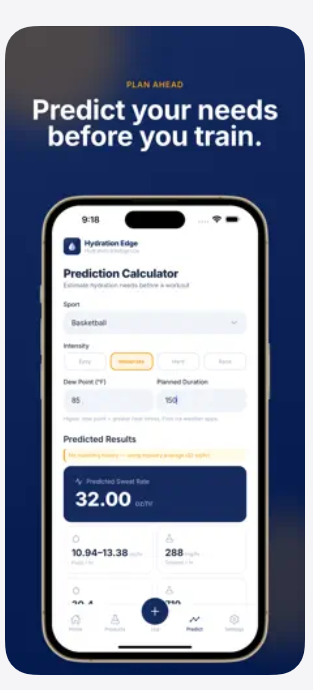
A mobile screen displaying the Hydration Edge app’s prediction calculator, calculating a predicted sweat rate of 32.00 oz/hr based on sport, workout intensity, and weather conditions.
Meet Hydration Edge: Personalized Hydration Without the Spreadsheet
For years, I’ve helped athletes calculate their individual sweat losses and translate their testing into hydration and fueling plans.
And there were spreadsheets.
Lots of spreadsheets.
Eventually that spreadsheet grew enough legs that I thought: There has to be an easier way to do this.
So we built one.
Hydration Edge helps endurance athletes capture their sweat-rate data, recognize their individual patterns, and use those patterns to plan fluid and sodium needs for different workouts and races.
Instead of trying to remember what happened on your last hot run or recreate a spreadsheet before race day, you can use your own data to help plan for what’s coming next.
Because your hydration strategy shouldn’t come from what your training partner drinks.
It shouldn’t come from a generic ounces-per-hour recommendation.
And it shouldn’t require you to start over every time your sport, distance, intensity, or environment changes.
Your body is already giving you the data. Hydration Edge helps you capture it, understand your patterns, and use it to plan what you need for training and racing.
Hydration Edge is currently available for Apple devices.
Want to Know What’s Actually in Your Sweat?
Knowing your sweat-rate pattern tells you how much fluid you’re losing.
Sweat testing can add another important piece: how much sodium you’re losing.
At The Endurance Edge, our sweat testing includes personalized results plus a one-on-one hydration consultation to help you understand how to put those numbers into practice.
Learn About Sweat Testing at The Endurance Edge
FAQs
Is sweat rate always the same?
No. Sweat rate can change with sport, exercise intensity, temperature, humidity, airflow, duration, and individual physiology.
How many times should I calculate my sweat rate?
Rather than relying on one workout, look for patterns across different conditions. In the episode, Chris suggests collecting approximately 3–5 observations per sport to begin understanding your individual patterns.
Is sweat rate the same as sodium loss?
No. Sweat rate tells you how much fluid you’re losing. Sweat testing can provide additional information about the sodium concentration of your sweat.
Why is my sweat rate higher indoors?
Reduced airflow can contribute to greater heat strain indoors. In the episode, Chris describes an athlete whose indoor cycling sweat rate decreased after adding a fan.
How do I know how much to drink during a race?
Rather than relying on one generic amount, use observations from similar sports, intensities, durations, and environmental conditions to better understand your individual hydration pattern.
Can a hydration app calculate my individual needs?
Hydration Edge was designed to help athletes use their own sweat-rate patterns to plan fluid and sodium needs for different workouts and races.