
XTERRA World Championship Italy: What I Learned Racing in Trentino
Racing the XTERRA World Championship in Trentino, Italy was one of the hardest, most beautiful, and most humbling experiences I’ve ever had as an athlete.
After qualifying at the USA National Championship in Alabama, I had the opportunity to race in Italy in September 2025. What followed was cold water, mud, mistakes, unexpected challenges, incredible scenery, and a powerful reminder that sometimes our greatest races are the ones that nearly break us.
How I Qualified for the XTERRA World Championship
I qualified through the USA National Championship in Alabama, where I placed second in my age group behind an athlete from Argentina. Because she was not from the United States, I earned the USA National Champion title and a spot at Worlds.
That alone felt surreal. Racing at the XTERRA World Championship had been a dream, and I was incredibly grateful for the chance to represent Team USA.
Why Trentino, Italy Is a Bucket List Destination
The race took place near Lake Molveno in Trentino, Italy, surrounded by the Dolomites. It was honestly one of the most beautiful places I have ever seen.
The mountains looked almost unreal. The water was crystal clear. There were incredible trails, mountain biking, delicious food, and scenery that looked like it belonged in a movie.
If you ever get the chance to visit this region—even if you are not racing—I highly recommend it.
The Swim: My First Open Water Panic Attack
The race began with an Olympic-distance swim in Lake Molveno. The course included an “Australian exit,” where athletes exit the water midway, run across a dock, and dive back in.
Before leaving for Italy, I expected water temperatures around 68–70°F and air temperatures near 60°F. I packed my shorty wetsuit, which I had used successfully for years. Then the weather changed dramatically.
By race day, the air temperature was in the low 40s, the water had cooled significantly, and I was the only person standing at the start in a shorty wetsuit. Everyone else had full wetsuits, long sleeves, neoprene caps—or all three.
I was too cold to warm up properly before the race. When the gun went off and I hit the water, I had my first true panic attack in open water. For nearly 200 meters, I could not put my face in the water or catch my breath.
Eventually, I settled in and found a rhythm. But every time we exited and jumped back into the water, I got cold all over again. It was a hard lesson in how much preparation, equipment, and cold-water practice matter.
What I Would Do Differently for a Cold-Water Race
- Bring a full wetsuit, even if the forecast looks warmer
- Pack extra layers like arm sleeves and a neoprene cap
- Practice Australian exits before race day
- Prioritize warming up, even in uncomfortable conditions
The Bike Course: Beautiful, Brutal, and Covered in Mud
The XTERRA bike course was a 32K mountain bike course split into two loops. On paper, it looked challenging. In reality, it was much harder than I expected.
There was a long climb with an average grade of 7% and sections reaching nearly 20%. Then came technical descents, bike park berms, muddy switchbacks, stairs through town, and slick conditions that turned the course into survival mode.
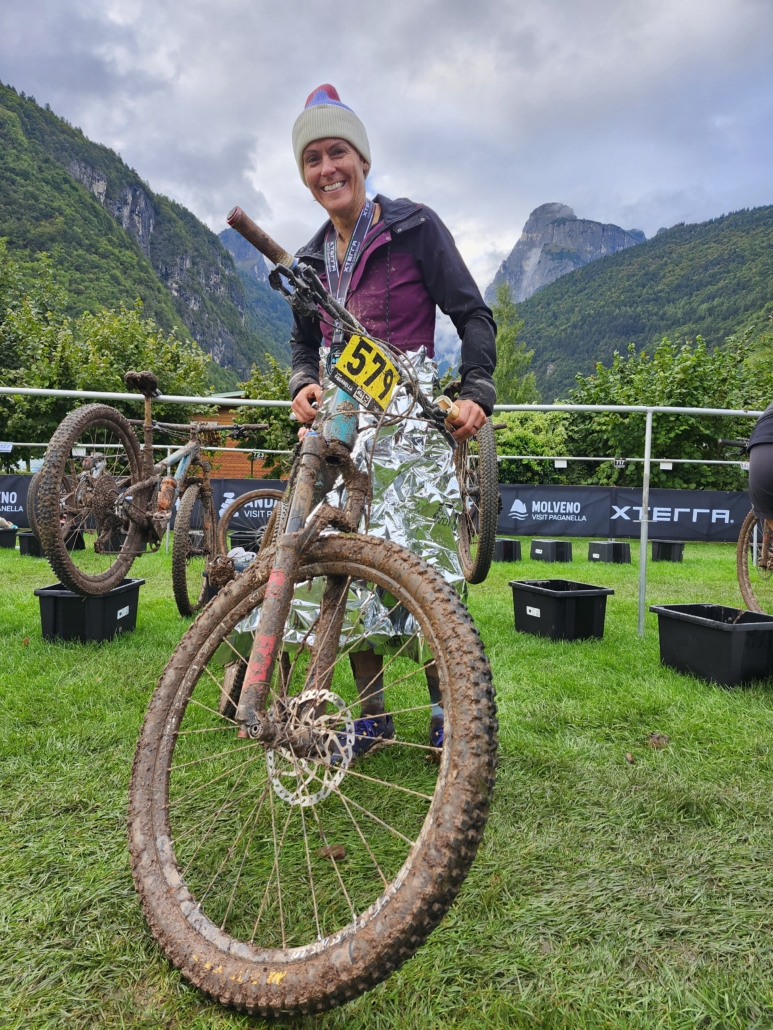
Because of the heavy rain the day before, the course was almost entirely mud. Athletes were slipping, dropping chains, hike-a-biking, and crashing. Even the pros struggled.
It took me nearly four hours to complete about 20 miles of biking because the conditions were so difficult.
The Biggest Bike Lesson I Learned
I trained for the course—but not specifically enough.
Looking back, I would have focused more on shorter, steeper climbs and power-based efforts rather than longer endurance climbs. I also would have changed my cassette to give myself more gearing for the steep sections.
One of the hardest parts was mental. I had worked hard to overcome my fear of mountain bike descents, and the mud made everything unpredictable again. On a mountain bike, everything works better when you stay relaxed and trust the bike. The more tense and over-controlled I became, the harder it was.
Transition Mistakes and Unexpected Race Penalties
One thing I learned quickly: XTERRA racing in Europe follows different rules than what I was used to in the United States.
In transition, every athlete had a box where all discarded gear had to go. I did not realize that, and I dropped my wetsuit on the ground like I always had in US races.
That mistake earned me a 15-second penalty on the run.
I also forgot to double-knot one of my shoes, which came untied during the run. By this point, I was laughing at myself because it felt like I had made every mistake possible.
The Run: Finally Feeling Like Myself Again
By the time I reached the trail run, I was relieved to be off the bike and moving again.
The run course included steep climbs, muddy trails, and another manmade obstacle, but I finally started to have fun. I found my rhythm, smiled, and felt like myself again.
At one point, I had to stop in the penalty box to serve my transition violation. Oddly enough, it helped because I finally had time to take my jacket off and wrap it around my waist. For the first time all day, I was warm.
The Most Important Lesson: You Belong Here
One of the biggest lessons from this race had nothing to do with wetsuits, gearing, or transition rules.
It was this:
We all question whether we are good enough, worthy enough, or capable enough.
Before this race, I put a lot of pressure on myself. I wondered whether I deserved to be there, whether I could live up to expectations, and whether I was enough.
But by the end of the day, none of that mattered.
The real challenge was showing up, facing something hard, and proving to myself that I could get through it.
What I’d Do Differently Next Time
- Pack for colder weather than the forecast suggests
- Bring a full wetsuit and additional cold-weather gear
- Practice race-specific skills like Australian exits
- Train more specifically for steep, technical climbs
- Use a different cassette for better climbing
- Study race rules and transition procedures more carefully
- Trust myself and enjoy the experience more

Would I Race XTERRA Worlds Again?
Absolutely.
It was messy, frustrating, exhausting, and far from perfect—but it was also unforgettable.
I left with no regrets, a deeper respect for the sport, and a story I will never forget. And yes, I would go back and do it again.
Afterward, we found an Italian café and had the best tiramisu I have ever tasted. Honestly, after a race like that, it may have been the most important recovery strategy of all.